

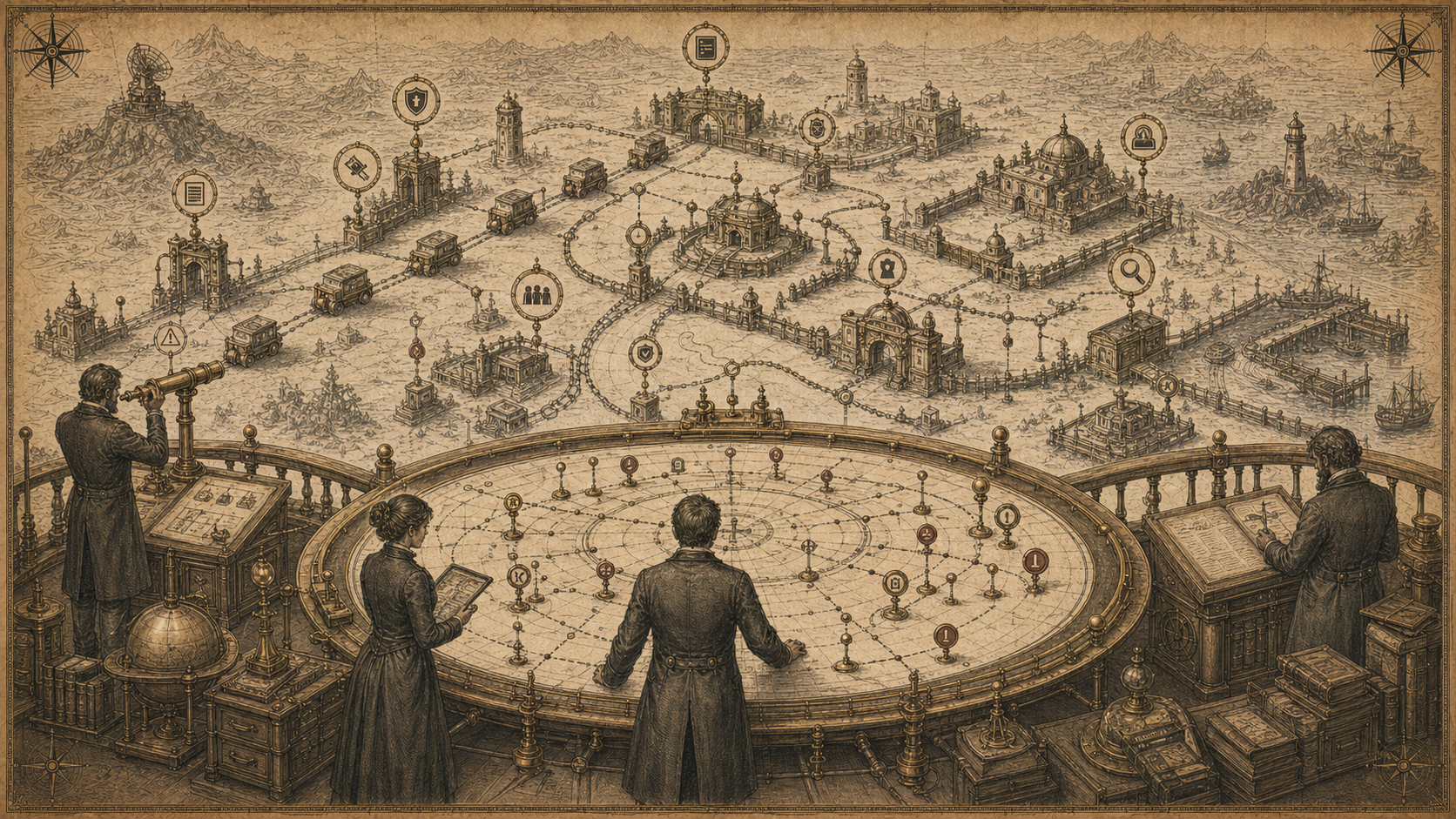
The developer platform has always had one user in mind: a developer. A person, at a keyboard, reading a UI, clicking a button, making a judgment. Every portal, every catalogue, every internal developer platform was a tool shaped around a human.
That user is no longer the only one, and soon may not be the main one.
What a developer increasingly does is delegate. To a coding agent that scaffolds the service, opens the pull request, provisions the environment, and asks the platform for what it needs. When that happens, the platform's real user is not the developer anymore. It is the agent the developer sent in their place. And almost nothing about how we built platforms assumed the user would be a machine.
This is the shift behind a phrase turning up on every analyst's slide this year: the agent-native developer platform.
The portal was a UI. The next platform is an API.
Strip a traditional developer platform down and its primary surface is a screen. A portal you log into. Forms you fill. Dashboards you read. The whole thing assumes eyes, a cursor, and a human who can interpret what they see.
An agent has none of those. It does not log into a portal. It does not read a dashboard. It calls things. For an agent, a beautiful UI is not a feature. It is a wall. The capability behind the screen is useless to it unless that capability is also exposed as something a machine can invoke, with a clear contract, predictable responses, and errors it can reason about.
So the centre of gravity moves from the UI to the API. The portal does not disappear, but it stops being the platform and becomes one client among several. The platform becomes the set of capabilities underneath, exposed so that a human portal and a non-human agent can both consume them.
The standard crystallising around this is the Model Context Protocol. MCP, launched by Anthropic in late 2024, defines how agents connect to external tools and data: servers expose capabilities, clients call them. Thoughtworks' latest Technology Radar puts it plainly: every major technology vendor is now building agent-awareness into its platform, largely because of MCP. Gartner points the same way with its talk of AI-native development platforms. The interface to the platform is becoming a protocol, not a page.
What "agent-native" actually means
It is worth being precise, because the phrase is about to be slapped on everything.
Agent-native does not mean an AI feature in your IDE. It does not mean a chatbot in the corner of the portal. It does not mean you bought a copilot. Those are AI features bolted onto a human platform. Agent-native means the agent is a first-class user of the platform, with the same rights, contracts, and constraints you would design for any important consumer.
Concretely, an agent-native platform treats four things as requirements rather than afterthoughts.
A machine-legible interface. Every capability that matters, provisioning, deployment, policy checks, environment teardown, is available as a typed, documented tool an agent can call, not just a screen a human can click. This is "when the consumer is a machine" turned into architecture: the platform's surface has to be legible to software, because software is now the thing using it.
Capabilities, not tickets. An agent cannot wait in a queue. If asking the platform for a database means filing a request a human fulfils, the agent stalls and the speed you bought evaporates. Agent-native platforms expose capabilities as self-service APIs that return the thing, not a ticket promising the thing later.
Guardrails as the surface, not a review after it. An agent will do exactly what its interface permits, so the interface has to permit only safe things. The controls move into the platform: the agent can request an environment, but only a compliant one; deploy, but only through the pipeline; touch data, but only what its identity allows. Safety becomes the shape of the API, not a reviewer who inspects the result.
Identity and evidence, built in. Every agent action runs under an identity, with least privilege, leaving an audit trail the platform emits on its own. You should be able to answer "which agent did this, under whose authority, with what permissions, and where is the proof" without assembling it by hand later. Oversight, as I have argued before, is a capability you build in, not a signature you collect after.
The trap: a wrapper is not a platform
Here is where most organisations will go wrong, and the people closest to this are already warning about it.
The tempting move is to take your existing platform, the one full of UIs and ticket queues, and bolt an MCP server onto the front so you can call it agent-ready. Thoughtworks flags exactly this: it puts naive API-to-MCP conversion on hold and cautions against reaching for the protocol by default. Wrapping a broken platform in a machine interface does not make it agent-native. It makes it a faster way to reach the same broken thing.
If the capability behind the new API is still a ticket queue, the agent now fills the queue faster. If the guardrail was a human reviewer, exposing the action to an agent removes the reviewer and keeps the risk. If there was no real audit trail, an MCP endpoint does not conjure one. Agent-native is a property of the substrate, not a layer you spray on top. And the substrate now has new ways to fail: MCP's own security weaknesses, tool poisoning, cross-server shadowing, a protocol built for ease rather than authentication, are exactly the kind of thing an immature platform exposes and a mature one contains.
This is the amplification pattern again, which I keep returning to because it keeps being true. DORA's 2025 report says AI amplifies the system it runs inside. Expose a clean platform to agents and you get leverage.
Expose a mess and you get the mess, industrialised, at machine speed, behind an API that makes it look modern.
The human becomes the control room, not the bottleneck
The fear underneath all of this is that agent-native means human-absent. It does not.
It means the human moves. Off the critical path of every individual action, where they were always a bottleneck, and up into the room where the policy, the boundaries, and the exceptions are decided. The agent acts through the platform. The human shapes the platform the agent acts through, reads the evidence it emits, and steps in where judgment is actually required.
This is the tiny teams, heavy systems picture finished. The small team is possible because the platform is heavy enough to let agents do real work safely. The humans are not typing every command. They are running the control room: setting constraints, reading signals, intervening on the exceptions, turning every repeated failure into a new guardrail. The platform is the harness. The agent-native platform is just a harness built for a faster, less judicious animal.
It is also, not by accident, the end of the vibe-coding era. Thoughtworks' CTO put it well: the industry's obsession with prompting that "feels right" has practically disappeared, replaced by serious work on context, infrastructure, and security. That is the boring turn I described. The agent-native platform is what the boring turn builds.
The reframe
For thirty years, the developer platform was a tool we made for developers. We optimised it for human eyes, human patience, and human judgment, and it worked because a person was always there to fill the gaps.
The next platform is made for the things developers delegate to. It optimises for a consumer that reads contracts instead of screens, acts in milliseconds instead of minutes, infers nothing, and waits for nothing. That consumer is unforgiving of every place your platform quietly relied on a human to make it safe.
You can meet it with a wrapper, an MCP server over a ticket queue, and find you have only automated your worst processes. Or you can build the platform the agent actually needs: capabilities as APIs, guardrails as the surface, identity and evidence by default, a human in the control room rather than the queue.
The interface was never the point. The interface was always the strategy.
And the platforms that matter from here will be the ones an agent can use without anyone holding their breath.
The Conversation
Members can comment on every field note.
Subscribe to join the discussion and add your perspective to the record.