

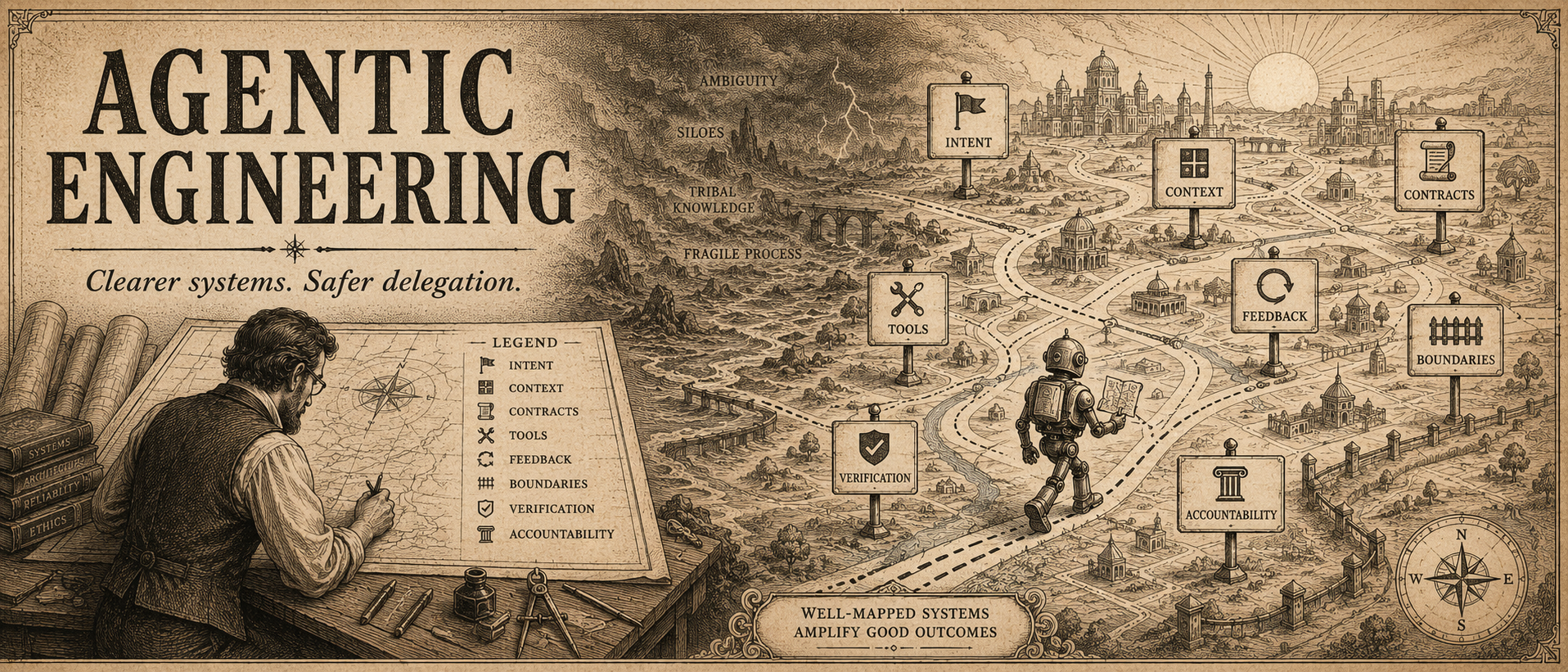
Agentic engineering is not the art of asking AI to do more. It is the discipline of making work explicit enough that machines can safely help with it.
For the last two years, most of the public conversation about AI and engineering has been trapped in a familiar argument. Will AI replace developers? Will junior engineers disappear? Will everyone become a prompt engineer? Is this just autocomplete with better marketing? Is it real engineering, or vibe coding dressed up for investors?
These are loud questions. They are not always useful ones.
The quieter question is more interesting: what changes when engineering work can be delegated to systems that can read context, make plans, call tools, modify artefacts, run checks, and come back with evidence?
That is the question behind agentic engineering. Not AI-assisted engineering, not prompt engineering, not code generation. Something different: an operating model where humans no longer interact with AI as a clever assistant in the margin, but as a set of bounded agents embedded inside the engineering system itself.
The point is not that agents become engineers. The point is that engineering has to become legible enough for agents to participate.
From autocomplete to delegation
The first generation of AI development tools was easy to understand. They completed code. You typed a function name, the model suggested the body. You wrote a comment, the model guessed the implementation. You forgot the syntax for a library, the model filled the gap. Useful, sometimes magical, sometimes wrong in extremely confident ways.
But the mental model was simple. The human did the work; the machine accelerated the keystrokes.
Agentic tools change the shape of the interaction. You do not just ask for a line of code. You assign a task. You point to an issue. You describe a bug. You ask for a refactor. You ask the system to inspect a repository, produce a plan, make changes, run tests, open a pull request, respond to review, and iterate.
The unit of work moves from the line to the task.
Autocomplete asks: what should I type next? Agentic engineering asks: what work can be safely delegated, how will the agent know what good looks like, and what evidence will prove it is done?
This is why the conversation cannot stay at the level of productivity. A faster typist is useful. A delegated actor changes the system.
The wrong question
The wrong question is: how much code can AI write?
It is attractive because it is measurable. Lines of code. Pull requests. Features. Tests. Time saved. Tickets closed. Demos produced.
But it misses the architecture of the problem. Code was never the whole of engineering. Engineering is deciding what should exist, why it should exist, what constraints it must respect, what trade-offs are acceptable, what failure means, what evidence counts, what risks remain, and how the system should evolve after it meets reality.
AI can generate code. That is no longer the interesting statement. The interesting question is whether the engineering system around the AI can make that generation useful, safe, coherent, and maintainable.
A model can produce a pull request. But who defined the intent? Who gave it the right context? Who constrained the design space? Who reviewed the diff? Who captured the lesson when it failed? Who turned the repeated correction into a rule, a test, a template, a contract, or a platform capability?
That is where agentic engineering begins. Not when an agent writes code, but when the organisation starts designing the environment in which agents can produce trustworthy work.
A working definition
Agentic engineering is the discipline of designing engineering workflows, artefacts, platforms, and controls so that AI agents can perform bounded work with context, tools, feedback, verification, and accountability.
It has five essential ingredients.
Intent: the agent needs to know what outcome is wanted, not just what activity to perform.
Context: the agent needs access to the relevant system state. Code, documentation, architecture decisions, tests, logs, incidents, product requirements, standards, constraints, previous decisions.
Tools: the agent needs safe ways to inspect, change, run, validate, compare, deploy, or report on the system.
Feedback: the agent needs signals that tell it whether it is getting closer to the desired outcome. Tests, type checks, linters, screenshots, traces, evaluations, reviewers, users, production telemetry.
Boundaries: the agent needs limits. Permissions, approval gates, cost controls, environment isolation, policy constraints, audit trails, escalation paths.
Remove any of these and the agent becomes either useless or dangerous. Intent without context creates confident nonsense. Context without boundaries creates exposure. Autonomy without accountability creates theatre.
Agentic engineering is not vibe coding
The phrase "vibe coding" names something real. A developer asks the model to build something, accepts a flow of generated changes, keeps going while it feels right, and only later discovers whether the system is coherent. For prototypes, this can be valuable. For production engineering, it is not enough.
Agentic engineering is almost the opposite. It is not a celebration of vibes; it is an attack on ambiguity. It asks for clearer tasks, stronger contracts, better tests, more explicit context, cleaner interfaces, sharper acceptance criteria, safer tools, and faster feedback loops.
The better the agent, the more this matters. A weak agent fails early and visibly. A strong agent can produce a large amount of plausible work before the organisation notices that the work is misaligned. That is the danger. Not that the machine is useless, but that it is useful enough to industrialise misunderstanding.
AI is not just a productivity multiplier. It is a system amplifier. If the engineering system is clear, agents amplify clarity. If the system is messy, agents amplify mess. This is why agentic engineering is not primarily about models. It is about the shape of the system the model enters.
Prompt engineering was the first layer
Prompt engineering mattered because early AI systems needed clear instructions. The prompt was the interface. Write the right instruction, get a better answer. Add examples. Add constraints. Add formatting. Add steps. Add guardrails. For many use cases, that was enough.
But agents operate over longer horizons. They read files. They run commands. They use tools. They call APIs. They remember. They plan. They consume context across many turns. They operate inside an environment.
At that point, the prompt is no longer the whole interface. The environment is the interface.
This is why recent industry conversations have moved from prompt engineering to context engineering, tool design, harness engineering, agent protocols, evaluation systems, and managed execution environments. The vocabulary is different, but the architectural idea is the same. Agents do not become reliable because we wrote a better sentence. They become reliable because we design the world around them so that the right context, tools, checks, and constraints are available at the right time.
The prompt still matters. It is no longer the architecture.
The harness is the product
One of the most important ideas in recent agentic engineering is the harness.
The harness is everything around the model that allows it to do useful work: repository structure, instructions, tests, scripts, tools, permissions, evaluation datasets, feedback loops, sandboxes, memory, documentation, workflows, review processes.
In traditional software engineering, we thought of the codebase as the product and the development environment as support. In agentic engineering, the environment becomes part of the product.
A repository with weak tests, unclear structure, outdated documentation, inconsistent patterns, hidden dependencies, flaky builds, and tribal knowledge is not just unpleasant for humans. It is hostile terrain for agents. A repository with strong contracts, clear tests, good documentation, obvious boundaries, reproducible environments, meaningful errors, and well-named tools becomes machine-readable engineering terrain.
Agentic engineering does not eliminate engineering discipline; it makes that discipline more valuable. The boring things become leverage. Tests become feedback for agents. Documentation becomes runtime context. Architecture decisions become navigation aids. Runbooks become executable workflows. Issue templates become task specifications. CI becomes the agent's sense of touch.
The machine does not make these practices obsolete. It makes their absence more expensive.
The engineer moves up a layer
A common fear is that agentic systems reduce the role of the engineer. The more interesting possibility is that they change the level at which engineering happens.
The engineer writes less of the first draft. They become more responsible for intent, decomposition, boundaries, verification, taste, and system learning. That is not a smaller role. It may be a harder one.
In agentic engineering, the engineer becomes closer to a platform designer, editor, reviewer, systems thinker, product translator, and operational governor. They define what good looks like. They encode constraints. They decide where autonomy is useful and where it is reckless. They create the feedback loops that allow agents to self-correct. They turn repeated mistakes into durable improvements. They decide which ambiguity should be resolved by software, which by policy, and which by human judgment.
This is why "human in the loop" is too weak a phrase. The human is not there to click approve on every machine action. The human is there to shape the system so that fewer meaningless approvals are needed, and the remaining approvals actually require judgment.
Agentic engineering is not humans doing the same job with faster autocomplete. It is humans designing a better division of labour between judgment and execution.
The new engineering artefacts
Agentic engineering changes the artefacts teams need to care about. Some are familiar: requirements, tests, code, pull requests, pipelines, logs, documentation, architecture decisions. But some become more important than before.
Agent instructions need to live somewhere versioned and reviewed, not in someone's prompt history. They should be improved like other engineering assets.
Task contracts package intent, scope, constraints, examples, verification criteria, and escalation conditions into a ticket the agent can execute against. A vague ticket produces vague work.
Tool contracts are not the same as APIs for deterministic systems. They need names, descriptions, schemas, permissions, examples, meaningful errors, and safe defaults designed for a non-deterministic caller.
Context maps tell agents which documents, decisions, systems, logs, and repositories matter for a given task. If context is scattered, stale, or contradictory, the agent inherits the confusion.
Evaluation harnesses let teams repeatedly test agent behaviour: can it fix this class of bug, follow this policy, avoid this unsafe action, use this tool correctly, recover from failure, escalate when unsure?
Autonomy policies decide what level of independence each task deserves. Some actions can be automated, some proposed, some require human review, some should be structurally impossible.
Review evidence is what reviewers need beyond the diff: the plan, assumptions, tests run, failures encountered, decisions made.
These artefacts are not bureaucracy. They are the scaffolding that lets agents operate without turning the engineering system into a slot machine.
The contract becomes the runtime
In a human-only engineering system, a weak contract can survive longer than it should. Humans compensate. They ask questions. They remember past incidents. They know which service owner to call. They understand that the API says one thing but the business process means another. They know which test failure matters and which one is noise.
Agents do not have that surrounding social context unless we give it to them.
This is why contracts become runtime infrastructure. API contracts. Data contracts. Event contracts. Tool contracts. Architecture contracts. Security contracts. Operational contracts. The contract is no longer a PDF for onboarding; it is what the agent uses to decide what is allowed, what is expected, what is safe, and what is complete.
When the consumer is a machine, the contract has to carry more meaning. Not just what a field is called, but what it means. Not just what an endpoint does, but when it should be used. Not just what a tool can do, but what assumptions it makes and what risks it carries.
Agentic engineering therefore rewards organisations that have invested in platform clarity: contracts, ownership, runbooks, environments, tests, deployment paths, standards, exceptions. The agent does not invent this clarity. It consumes it.
Verification is the new prompt
If there is one practical rule for agentic engineering, it is this: never delegate work without giving the agent a way to verify it. A task without verification is just a wish.
"Improve this component" is weak. "Refactor this component without changing behaviour; run the existing tests; add coverage for these edge cases; produce a before-and-after screenshot; keep the public API stable; open a pull request with the trade-offs explained" is stronger.
The difference is not verbosity. It is feedback. Agents need something to push against. Tests, type checks, linters, screenshots, benchmarks, policy checks, golden datasets, smoke tests, contract tests, security scans, observability queries, user journeys, acceptance criteria. Verification turns generated work into engineering work.
Without it, the human becomes the only feedback loop. That does not scale. It also creates the worst version of human oversight: tired people reviewing large volumes of plausible output without enough evidence to make a meaningful decision.
The more work we delegate, the more we need automated verification. Not because humans disappear, but because human judgment should be spent where judgment is actually required.
Agentic engineering is socio-technical
It is tempting to make agentic engineering a tooling story. Codex. Claude Code. GitHub Copilot. Cursor. Google Antigravity. MCP servers. Agent SDKs. IDEs. Terminals. Sandboxes. Background workers. These tools matter.
But the harder part is socio-technical. Who is allowed to delegate work? What work can agents do independently? Which repositories are agent-ready? Who owns the agent instructions? Who reviews agent-generated changes? How are mistakes fed back into the system? How do teams prevent agents from multiplying existing architectural debt? How do they stop speed from becoming entropy? How do they measure quality, not just throughput? How do they protect junior engineers from becoming prompt operators without developing engineering judgment? How do they protect senior engineers from becoming reviewers of endless machine output? How does architecture remain intentional when the cost of generating change collapses?
These are not model questions. They are operating-model questions. Agentic engineering is where AI strategy meets delivery discipline.
The risk is not that agents fail
The obvious risk is that agents fail. They hallucinate. They misunderstand. They overfit to examples. They ignore constraints. They call the wrong tool. They produce insecure code. They create brittle tests. They solve the symptom. They miss the architecture. They get stuck. They declare victory too early.
Those risks are real. But they are not the only risk.
The deeper risk is that agents succeed in the wrong system. They produce more code than the organisation can review. They close tickets that should have been challenged. They replicate bad patterns because those patterns are already in the repository. They make local improvements that increase global complexity. They generate documentation that sounds authoritative but does not reflect reality. They accelerate delivery while weakening design. They turn technical debt into technical sediment.
Agentic engineering does not remove the need for architecture; it increases the penalty for weak architecture. When change becomes cheaper, direction matters more.
A maturity model for agentic engineering
A simple maturity model might look like this.
Level 1: Assisted engineering
AI helps individuals write, explain, test, or debug code. The work remains local. The human drives almost every step. Productivity gains are real but uneven.
Level 2: Task delegation
Teams assign bounded tasks to agents. Agents can inspect repositories, make changes, run tests, and produce pull requests. Humans still manage most context and verification.
Level 3: Harnessed engineering
Repositories and workflows are designed for agents. Instructions, tests, tools, documentation, and CI pipelines are intentionally maintained as agent-facing infrastructure.
Level 4: Agentic delivery systems
Agents participate across the SDLC: backlog refinement, code changes, test generation, documentation, security checks, operational analysis, dependency upgrades, incident review, technical debt reduction. Autonomy is governed by policy and evidence.
Level 5: Self-improving engineering platform
The system learns from agent failures and human feedback. Repeated corrections become rules, tests, tools, documentation, templates, or platform capabilities. Agents help maintain the harness that makes future agents better.
Most organisations sit somewhere between Level 1 and Level 2. The marketing is usually at Level 5. The gap between the two is the work.
What good looks like
A good agentic engineering system has a particular feel. Tasks are clear. Repositories are navigable. Tests are meaningful. Documentation is current enough to guide action. Architecture decisions are discoverable. Tools have safe boundaries. Permissions are scoped. Agents can verify their own work. Humans see evidence, not just output. Failures become improvements to the system. Autonomy increases only where feedback loops are strong. The organisation measures quality, maintainability, reliability, security, and flow, not just volume.
The best sign is not that agents produce a lot of code. The best sign is that the engineering system becomes more explicit, more legible, more testable, more governable, and more honest about what it knows and what it does not.
That is the real promise. Not replacing engineers, but forcing engineering to become clearer about itself.
The future is not agent versus engineer
The least interesting future is one where we argue endlessly about whether agents are "real engineers". They are not humans. They do not own consequences. They do not understand organisations the way people do. They do not carry professional responsibility. They do not have taste in the human sense. They are not accountable.
But they can do work. They can read, search, draft, modify, run, compare, repeat, explore, surface options, produce evidence, reduce toil, and challenge the cost structure of engineering work.
So the question is not whether agents are engineers. The question is what kind of engineering system we need when agents become participants in the work. That is agentic engineering. A discipline for delegation without abdication. A way to increase execution without losing judgment. A way to let machines operate inside engineering systems without letting the system become machine-shaped nonsense.
The organisations that benefit most will not be the ones that buy the most agent tools. They will be the ones that make their work most legible: clear intent, clear context, clear contracts, clear feedback, clear boundaries, clear accountability.
That was always good engineering. Agents just make it impossible to fake.
The Conversation
Members can comment on every field note.
Subscribe to join the discussion and add your perspective to the record.