

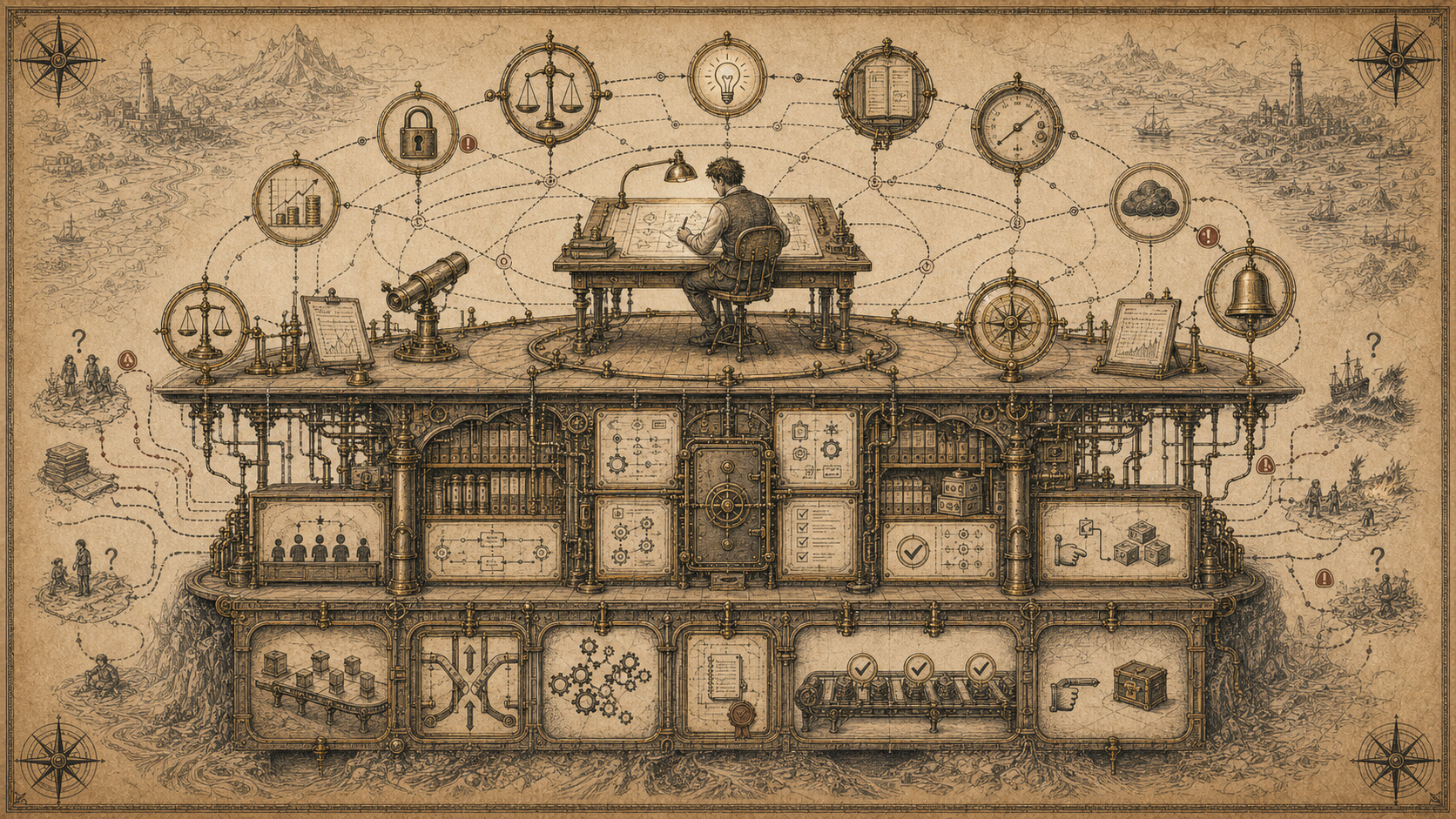
Shift left was a good idea that turned into a way of blaming developers.
The pitch was sound. Catch problems earlier, when they are cheap to fix. Move testing, security, and operational concerns out of the late stages and into the moment the code is written. Find the bug before it ships. Find the vulnerability before it is exploited. On paper, unarguable.
In practice, shift left too often meant shift onto the developer. Security shifted left and became the developer's job. Cost control shifted left and became the developer's job. Compliance, observability, infrastructure, the on-call pager: all shifted left, all landed on the same person, the one who was also supposed to be building the product.
The work moved earlier. It also moved sideways, onto whoever had the least room to refuse it.
The cognitive load nobody costed
There is a number missing from most shift-left initiatives, and it is the one that matters: how much can one person hold in their head?
A developer shipping a feature now also has to reason about the threat model, the cloud networking, the IAM policy, the cost of the query, the data classification, the Kubernetes manifest, and the six scanners in the pipeline. Each was added by a well-meaning initiative. Each is reasonable on its own. Together they are a tax on attention, and attention is the scarcest thing a developer has.
DORA names this directly. Its platform engineering work frames the goal as reducing developers' cognitive load: stop forcing every engineer to become an expert in Kubernetes, networking, and security policy, and absorb that complexity into the platform instead. The phrase DORA and Google Cloud use for it is shift down.
Developers are not careless. They are overloaded.
There is a story the security industry tells about developers: that they are lazy, that they skip the scan, that they cut corners. It is a comfortable story and it is wrong.
A developer whose bonus depends on shipping by Friday, facing a security scan that takes four hours and blocks the build, will route around the scan. Not because they do not care. Because they are a pragmatic professional responding to the incentives in front of them, and the incentive said ship. Put a control in someone's path as friction and they will treat it as friction.
Shift left created an enormous amount of this. It put more gates, more checks, more responsibilities in the developer's path, then acted surprised when overloaded people found the gaps. The problem was never the developer's discipline. It was a model that mistook adding a requirement for meeting it.
Shift down: move the complexity, not the responsibility
Shift down keeps the good half of shift left and drops the bad half.
The good half is timing: catch the problem early, before it is expensive. The bad half is location: make the developer personally responsible for the expertise. Shift down keeps the early and moves the expertise into the platform, where it is solved once by the people whose actual job it is.
The test of a shifted-down control is simple. Can the developer make the mistake at all?
Take the canonical example. Shift left tells a developer: please remember to enable versioning on your storage bucket, then runs a scanner that complains, after the fact, when they forget. Shift down writes a policy, in Terraform or Open Policy Agent, under which a bucket without versioning cannot be created in the first place. The developer is not asked to remember. They are structurally prevented from getting it wrong. The load of "did I secure the bucket?" drops to zero, because the question can no longer have a bad answer.
That is the whole move. The secure, compliant, correct choice stops being a task on a checklist and becomes the path of least resistance. The default. The only shape the platform will let you build.
What shifting down actually looks like
In practice it runs on three things, and none of them is a new scanner.
Defaults that are already correct. The paved road ships with logging, secrets handling, network policy, and cost guardrails already wired in. A developer who does nothing special gets a secure, observable, compliant service, because that is what the template produces. Doing the right thing takes no extra effort. Doing the wrong thing means leaving the road on purpose.
Feedback that arrives in context, fast. When something does need the developer's attention, it shows up where they are working, in seconds, in language about their change, not as a 200-page report from a nightly scan nobody reads. Fast feedback is a form of absorbed complexity: the platform did the analysis so the human only has to read the conclusion.
Choices removed, not just guarded. The strongest controls are the ones that are not decisions. Not "you should use the approved base image" but a build that can only use approved base images. Not "remember to rotate the credential" but a credential that rotates itself. Every choice you remove is cognitive load you delete rather than relocate.
The agent makes shift down non-optional
Here is where this stops being a developer-experience nicety and becomes structural.
An AI agent is, in a way, the most overloaded junior developer you have ever hired: fast, literal, tireless, and with no instinct for the unwritten rule. Shift a responsibility left onto an agent and you get the failure in its purest form. Tell it to "remember the security policy" and it will do something plausible. Run a scan it can route around and it will, just like the human, except faster and without noticing.
You cannot shift left onto something with no judgment. You can only shift down, into an environment the agent operates inside, where the secure path is the only path available to it. This is the same point as "when the consumer is a machine": a consumer that cannot infer needs the rules built into the surface it touches, not written on a wiki it will not read. It is also why I keep insisting the next phase of AI engineering is boring. The boring part is the platform quietly absorbing the complexity so that neither the human nor the machine has to carry it.
DORA's 2025 research reports that internal developer platforms are now nearly universal, with most organisations running one and a majority funding a dedicated team. Adoption is not the question anymore. Whether the platform absorbs complexity or just relocates it is.
Measure the load, not the gates
If shift down is the goal, then the metric is not how many controls you added. It is how little the developer has to hold.
A shifted-left organisation counts its scanners, its policies, its required checks, and calls the number progress. A shifted-down organisation asks a harder question: how many of these does a developer have to think about to ship safely? The right answer trends toward zero, not because the controls disappeared, but because they moved underneath the developer instead of standing in front of them.
I have argued that platform value is usually measured in the wrong place. This is the sharpest version of it. The value of a platform is the complexity it takes off the people building on it. Cognitive load is not a soft metric. It is the product.
The reframe
Shift left asked a fair question, catch problems early, and answered it by making developers carry more. For a while that looked like rigour. It was mostly redistribution: the same work, moved onto the people with the least capacity to absorb it, then measured as if adding the requirement were the same as meeting it.
Shift down asks the platform to carry what the developer should never have had to. Make the right thing the default. Make the wrong thing impossible. Put the expertise where it is solved once, not where it is forgotten daily.
Do not shift the work left onto people already at their limit. Shift the complexity down, into the platform built to hold it. The developers were never careless. They were just carrying your architecture in their heads.
The Conversation
Members can comment on every field note.
Subscribe to join the discussion and add your perspective to the record.