

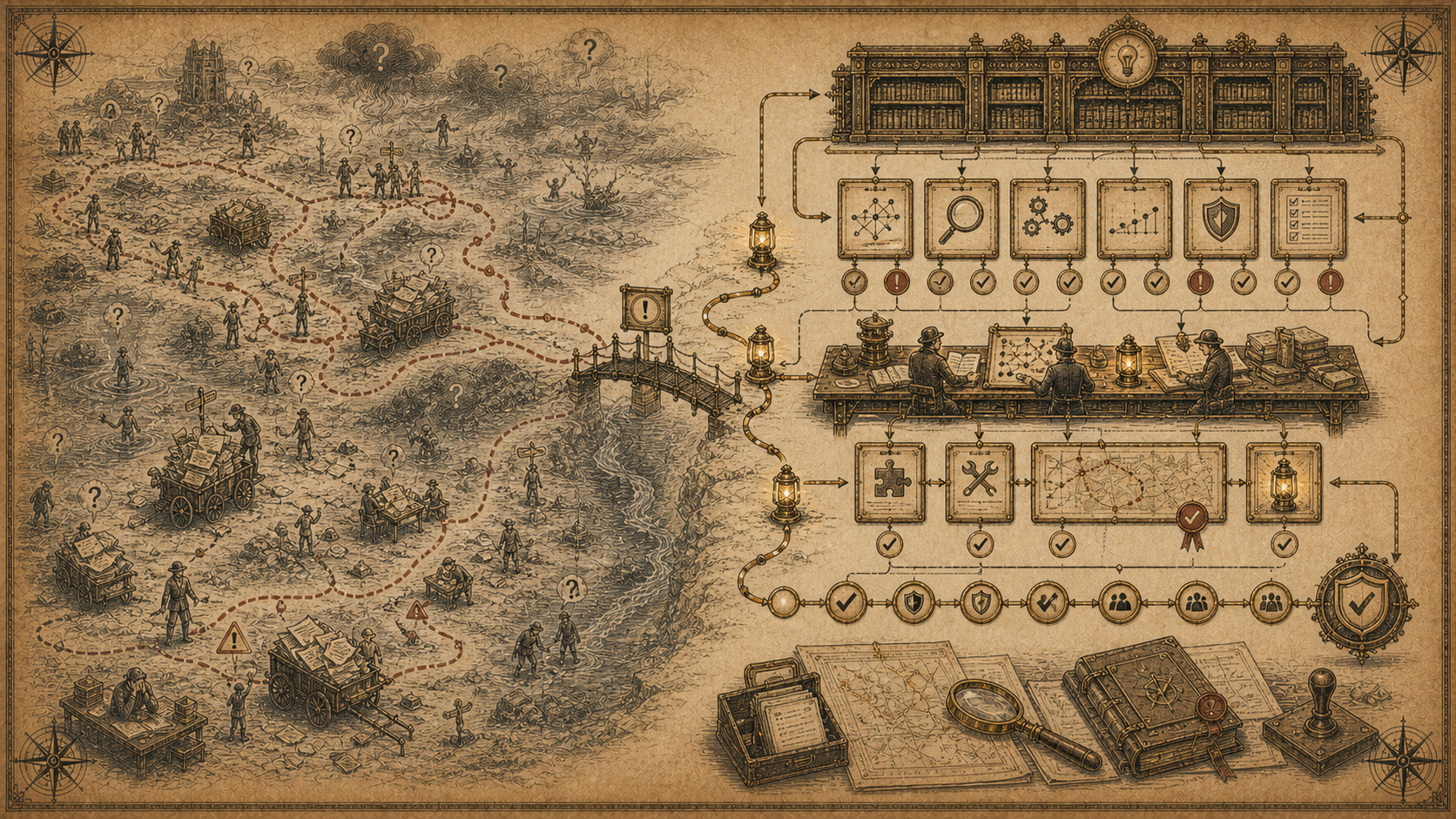
Nobody judges a platform when it works. They judge it the moment it breaks.
When the deploy goes through and the service comes up, the platform is invisible, which is exactly what you want. The verdict gets formed later, at the worst possible moment: when something has failed, the developer is blocked, and the only thing between them and a fix is whatever the platform chose to tell them. That message, the error, the log, the diagnostic, is the platform's real interface. Everything else is the brochure.
Most platform teams build the brochure and neglect the interface.
The capability that actually moves the needle
DORA went looking for which platform capability correlates most with developers actually liking the platform they use. The answer, in its 2025 data, was not the breadth of features, the elegance of the portal, or the number of integrations. It was clear feedback on the outcome of their tasks.
That should be a little humbling, because it is not where most platform investment goes. The capability most associated with a good developer experience is the one teams most often treat as an afterthought: telling the user, clearly, what just happened.
The mechanism is self-sufficiency. A developer who understands what failed and why can fix it and move on. A developer who hits a wall of cryptic output cannot, so they do the expensive thing instead: file a ticket, interrupt a colleague, post in the channel, or quietly give up and route around your platform. Clear feedback is the difference between a user who serves themselves and a user who becomes someone else's problem.
Feedback is not a support feature
Here is the mistake, stated plainly. Teams treat feedback as support: something adjacent to the product, a polish item, a thing to improve later once the real features ship.
So the happy path gets the attention. The demo works. The golden case is smooth. And the failure paths, which is where users actually spend their hardest minutes, get whatever was left over. The deploy fails with exit code 1. The pipeline goes red with a stack trace from deep inside a tool the developer has never heard of. The job silently does nothing. The portal shows a spinner that never resolves. Each of these is the platform, at the exact moment its quality matters most, choosing to say nothing useful.
You did not skip a support feature. You shipped a bad product and hid the defect in the one place every user eventually looks.
What "clear feedback" actually means
It is worth being concrete, because "better error messages" is too vague to act on. Clear feedback does four things, and most failures manage none of them.
It says what happened. Not that something failed, but what. "Deployment failed" is not feedback; it is a notification that feedback is needed. "Deployment failed: the service did not become healthy within 5 minutes" is a fact a person can work with.
It says why. The cause, not just the symptom. A health check that timed out is a symptom. "The container exited because it could not reach the database: connection refused on port 5432" is a cause. The difference is whether the user has to go investigating or can start fixing.
It says what to do next. This is the most underrated feature in platform engineering, and the rarest. A repair hint turns a dead end into a next step: "your service requested 4 CPUs, but your team's quota is 2. Lower the request, or ask your platform admin to raise the quota here." A failure that tells you how to recover is worth more than three features that never break.
It is where you would look, and readable when you get there. Feedback buried in a system the developer cannot reach, or dumped as ten thousand lines of internal state, is not feedback. It is plausible deniability. The log has to be findable, and written for the person hitting it, in their context, not for the engineer who built the platform.
Put those together and a failure stops being a slammed door and becomes a conversation: here is what happened, here is why, here is what you do now. That is a product talking to its user. The stack trace was just noise with a timestamp.
The economics are not subtle
The reason this matters so much is that the cost of a platform, to the people who use it, is dominated by the time they spend stuck.
Every opaque failure is a tax. It becomes a ticket someone has to triage, an interruption to the one engineer who knows what that error really means, a context switch, an afternoon lost, a small withdrawal from the account of trust the platform was slowly building. Multiply that by every developer and every failure and the bill is enormous, and almost none of it lands on the platform team's own ledger. It is paid by everyone else, in the currency of being blocked.
Clear feedback is how a platform scales without scaling its support team. DORA frames a good platform as one that makes failure cheap and recovery fast, and feedback is the lever for both. I have argued that platform value is usually measured in the wrong place. This is the sharpest practical example. The value is not in the failures you prevented. It is in how quickly the user recovered from the ones you did not.
When the user is a machine, feedback is the whole control loop
Everything above gets more pointed when the thing reading the error is an agent.
A human hitting a cryptic failure can muddle through: guess, search, ask a colleague, apply intuition the platform never gave them. An agent cannot muddle. It has only the feedback the system returns. If that feedback is a bare exit code, the agent is blind, and a blind agent does the dangerous thing: something plausible. If the feedback is clear, structured, and actionable, the agent can do what feedback is for, correct itself and try again, without a human in the loop.
This is when the consumer is a machine applied to the failure path. For a human, clear feedback is good experience. For an agent, it is the control loop, the only signal it has to close the gap between what it tried and what it should do next. I have made the case that the next phase of AI engineering runs on verification and fast feedback rather than clever prompts, and this is where that lives. An agent is exactly as capable as the feedback its environment gives it. Starve it of diagnostics and no amount of model quality saves you.
Treat it like the product, because it is
If feedback is the product, then it deserves what the product gets.
Budget it like a feature, not a chore. Test your failure paths with the seriousness you give the happy path, because for the user the failure path is not the edge case. It is the main event. Write error messages with the care you would give documentation, because that is what they are: documentation delivered at the exact moment it is needed. And measure the thing that matters: when your platform fails, can the user, human or machine, understand what happened and recover without asking a person? Every "how do I read this error?" is not a support question. It is a product bug.
The reframe
Think about the platform you remember fondly. Odds are it is not the one with the most features. It is the one that, the day everything went wrong, told you exactly what had happened and exactly what to do about it, and let you fix it yourself and get on with your life.
That is not the platform's support working well. That is the platform working well. The logs, the diagnostics, the explainable failures, the repair hints: these were never the wrapping around the product. On the day it counts, they are the product.
Build the failure path like you mean it. Clear feedback is not how you support what you made. It is the most important thing you make.
The Conversation
Members can comment on every field note.
Subscribe to join the discussion and add your perspective to the record.