

Why it is no longer just infrastructure
For a long time, the data platform was treated as a supporting layer. A place where data was collected, transformed, stored, and occasionally queried. It existed to feed reporting, enable analytics, and keep information available for the rest of the organization. Important infrastructure, but still infrastructure.
That mental model is starting to break. Not because dashboards improved or storage got cheaper, but because the role of the platform changed underneath everyone's assumptions.
The modern data platform is no longer just where data goes. It is increasingly where operational meaning is assembled, where decisions are triggered, where policies are enforced, where automation takes context from, and where the organization becomes legible enough to act at scale.
The platform is moving from the background to the center. From passive support function to active execution layer. From reporting substrate to organizational runtime.
Or, more bluntly: the modern data platform is becoming something closer to an operating system.
Why the comparison holds
That may sound exaggerated until you look at how modern organizations actually work.
Applications still matter. Operational systems still create and consume transactions. Teams still build products, APIs, services, and user interfaces. But the coordination of those systems increasingly happens elsewhere. Events are captured as they occur. Signals are joined across domains. Policies are applied centrally. Real-time decisions are pushed back into operational workflows. AI systems consume that context. Internal tools rely on it. Monitoring, governance, cost attribution, lineage, and compliance all depend on it.
The platform is no longer watching the business. It is participating in it.
Once you see that, a lot of otherwise disconnected trends start making more sense. The rise of event-driven architectures. The growing importance of streaming. The obsession with lineage and observability. The pressure for stronger governance. The need for shared semantic layers. The push toward data products, domain ownership, and platform engineering. Even the recent excitement around AI fits here: AI systems do not run on raw storage. They run on accessible, governed, contextualized organizational knowledge.
The common thread is that the enterprise needs a system that does more than store data. It needs a system that coordinates how data becomes action.
That is what operating systems do.
What an operating system actually provides
An operating system does not create the purpose of a machine. It creates the conditions under which everything else can run predictably. It manages resources, enforces boundaries, coordinates execution, provides common services, and allows different processes to interact without collapsing into chaos.
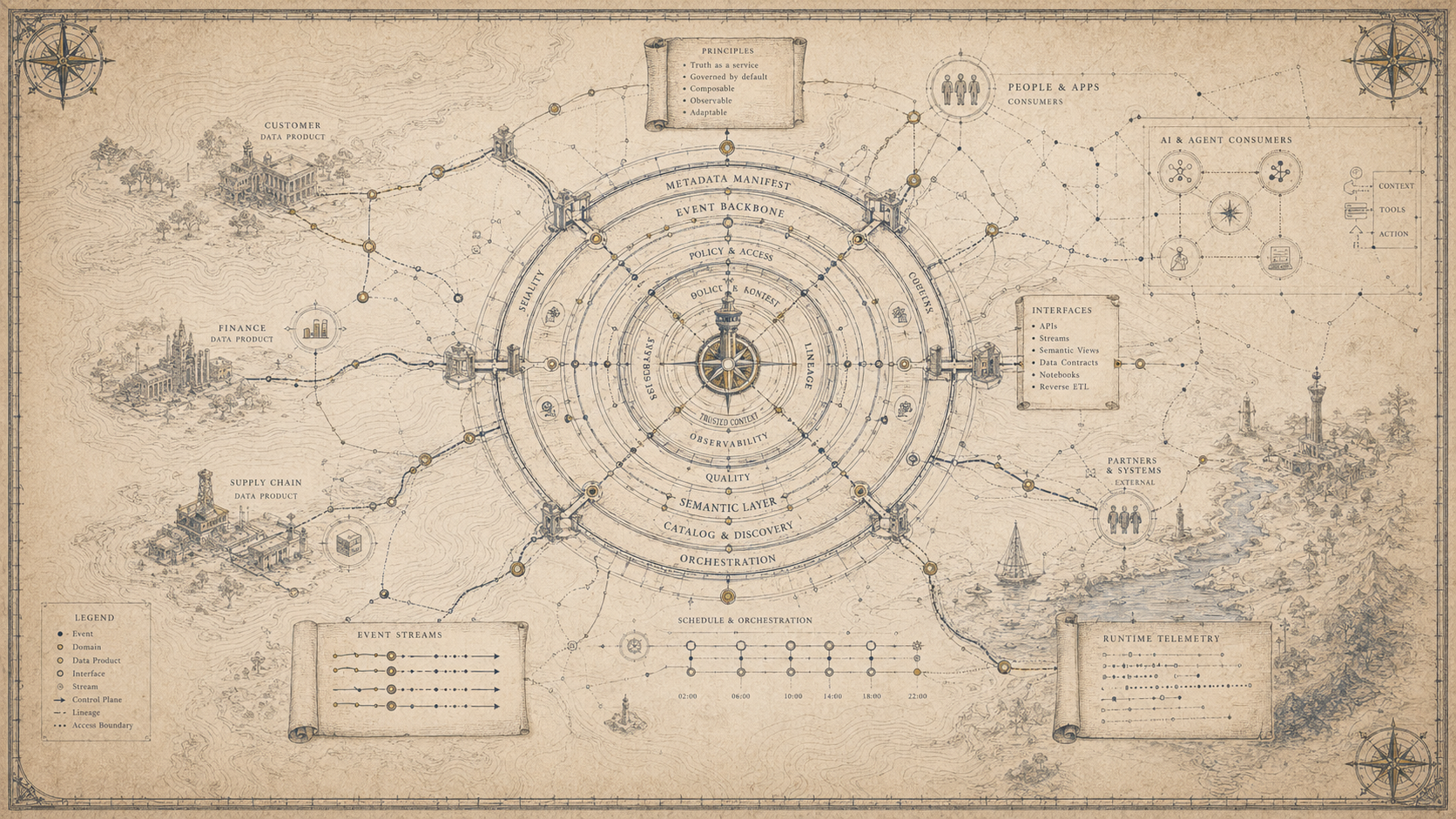
That is what a modern data platform is expected to do. It manages the flow of information across the enterprise. It allocates compute and storage. It orchestrates processing. It exposes common interfaces. It enforces permissions and policies. It tracks lineage. It provides observability. It supports multiple workloads with very different needs. And it creates a shared operational environment in which decisions can be made and automated.
That is not a reporting tool. That is a runtime.
The distance between signal and action is shrinking
For years, many organizations could avoid recognizing this shift because the consequences of bad data architecture were relatively contained. A slow dashboard was frustrating, but survivable. A late report created delay, but not systemic instability.
That world is fading. Organizations now expect data systems to support pricing decisions, operational alerts, customer interactions, risk controls, predictive models, process automation, and AI-driven workflows. The expectation is no longer that platforms explain what happened yesterday. The expectation is that they help shape what happens next.
Once a system participates in decisions, latency matters differently. Consistency matters differently. Governance matters differently. The platform can no longer be treated as an inert repository at the end of a pipeline. It becomes part of the logic of the enterprise itself.
Where organizations get stuck
Many organizations still describe their data platform using the language of the previous era. Storage choices, ingestion patterns, tooling categories, analytics capabilities. They debate warehouse versus lakehouse, batch versus streaming, centralized versus federated. Those questions matter, but they are no longer the core question.
The deeper question is: what is the platform responsible for in the operating model of the organization?
If the answer remains "collecting and serving data," the architecture will usually underperform. The real demand being placed on the platform is broader. The business is not asking only for access to data. It is asking for coordinated, reliable, governed action based on shared signals.
What this actually looks like
I am currently involved in building a platform inside a large airline to handle exactly this kind of problem. The airline needs to improve how it responds to operational disruptions: delays, gate changes, turnaround performance, ground handling coordination. Each of these problems involves combining signals from multiple operational systems (departure control, ground handling, AI-based camera monitoring, crew scheduling) and pushing responses quickly enough to actually matter.
The team is not starting by building dashboards. We are building an event backbone, with a manifest system that lets domain teams declare their data products as structured definitions: what events they publish, what schemas they use, what downstream consumers exist, what quality contracts apply. The manifest is becoming the source of truth. It feeds into a catalog (so teams can discover what exists), a "builder" (which generates IaC from the manifest and deploys infrastructure automatically), and a governance layer (which can detect breaking schema changes before they reach production).
This is not a dashboard problem. It is not even a machine learning problem. It is a platform problem. The organization needs a layer that can ingest signals continuously, reconcile context across domains, enforce quality and governance, expose the right abstractions, and support both human and automated decision-making.
And that is exactly the kind of system that behaves much less like a data warehouse and much more like a shared system service.
Plumbing versus coordination
The old view of the data platform as plumbing is becoming insufficient. Plumbing moves water. An operating system coordinates activity.
A plumbing mindset produces architectures optimized for transport and storage. An operating system mindset produces architectures optimized for coordination, control, and safe execution. The first asks whether data can get from source to destination. The second asks whether the organization can rely on the platform to support continuous decision-making without creating fragmentation, inconsistency, or governance breakdown.
This is also why so many data platforms feel strangely incomplete despite heavy investment. Technically, they may be sophisticated. There may be streaming infrastructure, a lakehouse, orchestration tools, cataloging, transformations, dashboards, and self-service layers. But the whole thing behaves like an assembled toolkit rather than a coherent system. Capabilities exist, but they do not compose. Governance exists, but it feels bolted on. Domain ownership exists, but platform boundaries remain unclear.
In other words, many organizations have built data infrastructure without yet building a real data operating system.
Mapping the analogy
This is where thinking in operating system terms becomes useful. Not because the analogy is perfect, but because it forces a more disciplined architectural conversation.
If the data platform is an operating system, then what plays the role of the kernel? Usually some combination of event backbone, metadata, identity, policy, and orchestration. In the airline platform I am working on, this is Kafka plus the manifest system plus the breaking-change detection layer. What plays the role of memory and storage? Warehouses, lakehouses, serving layers, caches, domain stores. What are the processes? Data products, pipelines, analytical workloads, machine learning workflows, operational consumers, internal applications. What is the scheduler? Workflow orchestration, stream processing, resource management. What handles permissions and isolation? Governance, access controls, policy engines, lineage, tenancy models. What provides system calls and common services? APIs, shared transformations, semantic layers, discovery, observability.
Once framed this way, the weakness of many current platform strategies becomes easier to see. They optimize components without designing the system. They invest in tools without being explicit about the runtime model. They pursue self-service without defining the rules of the environment. They decentralize ownership without creating enough shared control.
The result is a platform that is powerful in theory, difficult in practice, and only partially trusted by the people who depend on it.
Trust is the real variable
Operating systems succeed not because they are invisible, but because they are dependable. They create confidence that processes can run, interact, and evolve without every team having to renegotiate the fundamentals each time.
At the airline, I am watching this play out in real time. When a new domain team wants to onboard an AI vendor's event stream, can they discover what already exists in the catalog? Can they understand who owns what? Can they rely on schema definitions? Can they consume data without worrying that an upstream team will push a breaking change unannounced? Can governance be enforced without filing a ticket and waiting two weeks?
These are not hypothetical questions. They are the ones we answer every sprint. The teams that trust the platform ship faster. The teams that do not trust it build workarounds, duplicate pipelines, and maintain their own private data stores. Same infrastructure underneath, completely different outcomes, separated by whether the platform behaves like a system or a parts bin.
If those questions do not have good answers, the platform is still infrastructure in the old sense, however modern its technology stack appears.
AI will make this even more visible
AI systems are unusually demanding consumers of platform maturity. They need accessible context, not just raw datasets. They need metadata, semantics, and lineage. They need trustworthy access patterns. They need policy enforcement and observability. They need feedback loops. They need enough system coherence that generated outputs can connect to actual organizational meaning.
This is one reason why so many AI initiatives feel more like platform stress tests than isolated innovation efforts. They reveal whether the organization has built a real shared runtime for knowledge and decisions, or merely accumulated a set of disconnected data capabilities.
AI is not simply another workload for the data platform. It is a forcing function that exposes what the platform really is. If the platform is coherent, AI can amplify it. If the platform is fragmented, AI will amplify that too.
That should sound familiar, because it is the same pattern discussed in the first article of this series. AI does not magically fix weak systems. It reveals them.
A different starting question
A more mature response starts with a change in posture. Not "what tools do we need for our data platform?" but "what kind of operating environment does the organization now require?"
That leads to better design choices. It forces attention toward shared services, stable interfaces, domain boundaries, platform product thinking, and governance that is built into the runtime rather than added after the fact. It makes metadata strategic. It makes identity and policy strategic. It makes observability strategic. It shifts the conversation from moving data to coordinating behavior.
The modern data platform is not replacing applications. It is not becoming the only platform that matters. But it is becoming the layer that determines whether the rest of the organization can operate with coherence, speed, and trust.
A platform that merely stores and serves data is no longer enough. The enterprise needs a platform that can act as a shared runtime for decisions, automation, governance, and adaptation. A platform that can support multiple domains without collapsing into duplication. A platform that can expose common services while respecting distributed ownership. A platform that can make context operational.
The future of the data platform will not be decided by who can ingest more data, query it faster, or orchestrate more pipelines. It will be decided by who can design the cleanest control layer for the organization. The clearest boundaries. The most dependable abstractions. The most trusted coordination model.
Because in modern enterprises, the hard problem is no longer getting data somewhere. It is making the organization runnable. And increasingly, that is the job of the platform.
This is why I see the data platform not as a back-office utility, but as one of the defining architectural questions of the next decade. Not because data became fashionable, but because the platform has quietly moved into the space where action, meaning, and control meet. That is operating system territory. And many organizations are already there, whether they have named it or not.
In the next article, I will look at one of the architectural shifts that made this transition possible: why the distinction between batch and streaming is becoming less useful, and why event-driven thinking is increasingly the more important boundary.
The Conversation
Members can comment on every field note.
Subscribe to join the discussion and add your perspective to the record.