

A few years ago, most engineering organizations were constrained by the same thing: writing code was expensive.
Not just in budget terms. Expensive in attention. In coordination. In the only way that actually matters in complex environments: every meaningful change required someone, somewhere, to understand what they were building.
That cost shaped everything.
It slowed teams down. It created bottlenecks. It irritated delivery managers. It made roadmaps slip. It forced difficult prioritization. For years, the ambition of engineering leaders was to reduce that friction as much as possible.
But that friction had a hidden virtue.
It forced clarity.
Before something reached production, someone usually had to stop and ask the questions nobody had answered properly. What exactly does this requirement mean? Which system owns this data? What happens in edge cases? Is the language in the ticket aligned with how the business actually thinks? Are we solving the real problem, or just implementing the nearest interpretation of it?
Those questions never appeared on project plans or status reports. They looked like delay. They looked like inefficiency. But more often than not, they were the thing preventing weak ideas from quietly turning into production behavior.
That is what is changing now.
With AI-assisted development, execution is getting dramatically cheaper. A capable engineer with the right tools can generate in minutes what previously took hours. Endpoints appear from prompts. Boilerplate disappears. Tests get scaffolded. Documentation gets summarized. Entire slices of implementation come out with astonishing speed.
This is real progress. But it creates a dangerous misunderstanding.
The misunderstanding is that faster code generation automatically means better engineering.
It does not.
AI is not a productivity multiplier. It is a system amplifier.
It does not improve the underlying quality of your engineering environment. It reveals it. It accelerates it. It scales it!
If your systems are coherent, explicit, and well-governed, AI creates enormous leverage. If your systems run on ambiguity, tribal knowledge, inconsistent naming, and undocumented decisions, AI will amplify those conditions with exactly the same efficiency.
That is the uncomfortable truth at the center of this shift.
AI does not remove chaos.
It industrializes it.
Consider a very ordinary example.
A ticket appears in the backlog: “Expose customer status in the API.”
At first glance, this looks simple. The kind of request that appears small enough to estimate quickly, harmless enough not to trigger concern, and familiar enough that most teams would expect it to move fast.
But this is precisely the kind of requirement that carries invisible risk.
What is “customer status”? Active or inactive? Premium, standard, suspended, or in arrears? Is it the billing status, the CRM status, the service status, or some composite view the business uses informally? Is it updated in real time? Is it cached? What happens when two systems disagree? Which one becomes the source of truth?
Before AI, a decent engineer would slow down here.
They would ask questions. They would inspect the existing model. They might message a product manager, speak to another team, search for an old design note, and eventually discover what most large organizations discover over and over again: three different parts of the business use the same word to mean three different things.
None of this looks efficient on a dashboard.
But it is doing essential work.
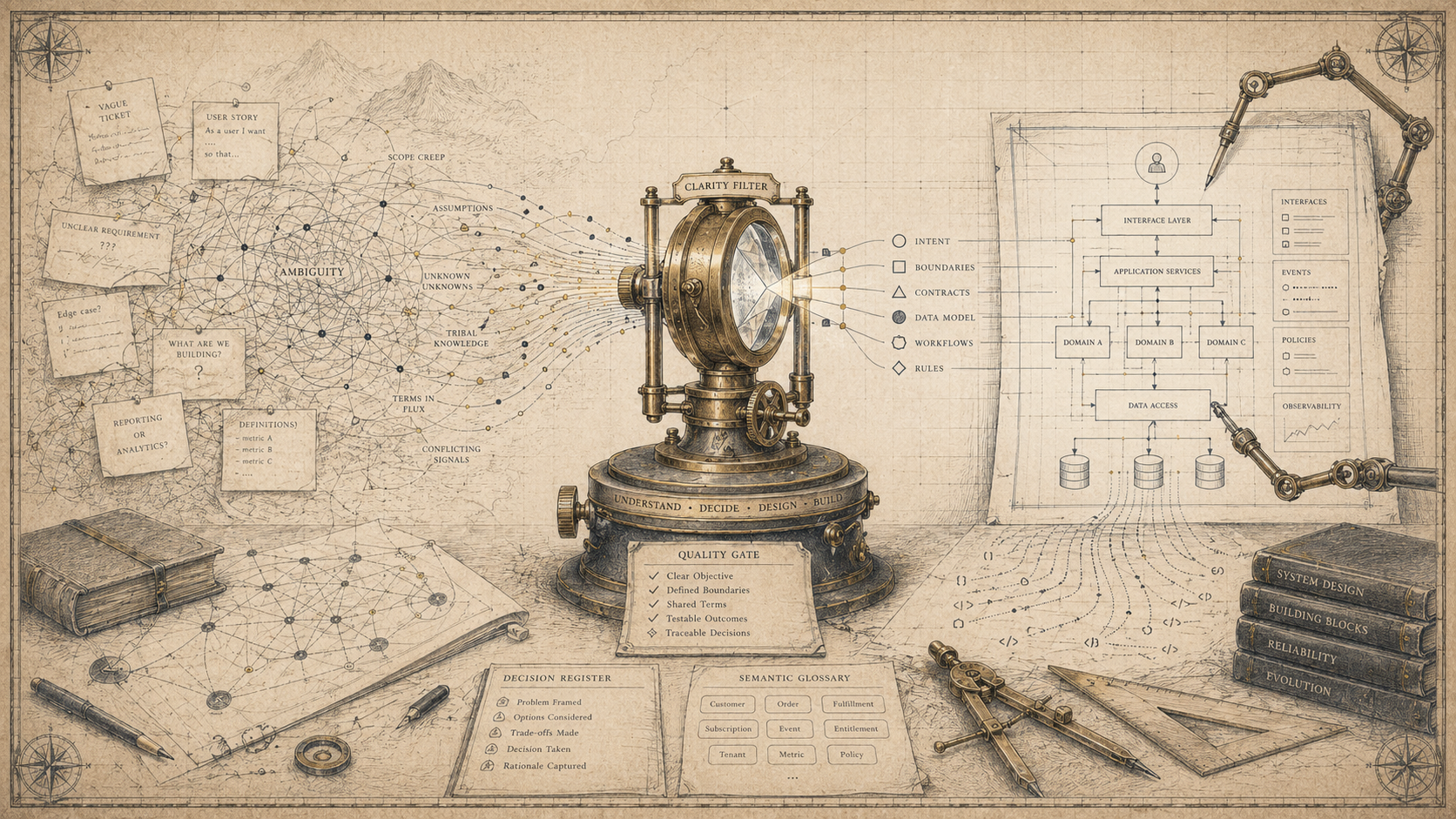
The engineer is acting as a filter between ambiguity and production.
Now replay the same scenario with AI in the loop.
The requirement gets dropped into an assistant. The surrounding codebase provides patterns. A plausible implementation comes out almost instantly: a new field in the response payload, some mapping logic, maybe a test suite, maybe even a documentation update.
Everything looks good.
It compiles. It passes. It gets merged.
And yet the result may still be wrong in the most dangerous possible way: not visibly broken, just subtly misaligned with reality.
The term “status” has been interpreted rather than clarified. The source of truth has been assumed rather than decided. Existing inconsistencies have been encoded rather than resolved. A gap that previously would have triggered a conversation has instead been converted into executable software.
That is the shift.
What used to become a question now becomes code.
- Ambiguity used to slow implementation. Now ambiguity survives implementation.
- Engineers used to ask clarifying questions. Now systems generate plausible answers.
- Friction used to expose weak definitions. Now speed hides them.
- Code used to be expensive. Now understanding is.
Once you see that clearly, a much larger realization follows.
The bottleneck in engineering was never just coding.
Coding was the visible constraint. Understanding was the real one.
For years, many organizations benefited from a hidden subsidy: skilled engineers compensating for weak system hygiene. They translated vague requests into implementable tasks. They reconciled conflicting data definitions. They carried undocumented context in their heads. They knew the history, the politics, the hidden dependencies, the things that “everyone knows” but nobody writes down.
Human judgment absorbed the entropy of the organization.
AI changes the economics of that arrangement.
It does not absorb entropy. It consumes whatever context is available and produces the most plausible continuation. That is a very different behavior. Ambiguity does not slow the system down in the same way. It passes through. Quietly. Efficiently. At scale.
I think this is why so much of the current conversation about AI in engineering feels slightly off. We talk about speed, automation, and productivity, but those are only the surface effects. The deeper change is that AI is removing a layer of human friction that used to act, however imperfectly, as a quality filter.
Not all friction was waste.
Some friction was exposing what the system did not know. Some was forcing alignment before implementation. Some was the difference between “we think we mean this” and “we have actually agreed what this means.”
When you remove all friction, you do not just remove delay.
You also remove one of the last informal safeguards many organizations still rely on.
This is why early AI adoption often feels impressive before it feels unsettling. Velocity improves. More gets shipped. Teams appear faster. But underneath that acceleration, another kind of risk starts to build up.
Not more bugs, necessarily. Not spectacular outages. Something harder to spot and more expensive over time.
Systems that are confidently wrong.
APIs that make sense locally but not globally. Features that work in isolation but drift from business intent. Data models that are syntactically clean and semantically weak. Documentation that accurately reflects implementation but not meaning. Software that is coherent enough to survive, but misaligned enough to become brittle, expensive, and difficult to evolve.
This is what happens with AI-generated output in messy environments.
Not bad code.
Plausible code built on weak foundations.
At this point, the conversation has to move beyond tools.
In an AI-enabled engineering organization, your backlog is no longer just a planning mechanism. It is part of the execution environment. Your tickets do not just describe work; they shape generated behavior. Your documentation is not a passive archive; it becomes active context. Your architecture is not just a communication device for humans; it becomes implicit instruction for machines.
Your system is now the prompt.
Requirements feed into documentation, which feeds into architecture and boundaries, which feed into generated implementation, which becomes production behavior.
And most enterprise prompts are terrible.
They are fragmented across Jira tickets, half-maintained Confluence pages, Slack threads, meeting notes, inherited naming conventions, old diagrams, tribal knowledge, and unwritten assumptions held together by the memory of a few experienced people. That environment was always fragile. AI just makes the fragility visible.
I suspect the next frontier in engineering will not be about who can generate the most code. It will be about who can build systems in which correct code can be generated reliably.
That is a less glamorous challenge. But it is the more important one.
- It means treating clarity as infrastructure.
- It means writing requirements that express intent, not just output.
- It means making decisions explicit, especially the ones everyone thinks are obvious.
- It means reducing terminological drift across systems.
- It means defining ownership properly.
- It means treating architecture not as a collection of diagrams, but as the set of boundaries, assumptions, and contracts that keep meaning stable as execution accelerates.
Most of all, it means recognizing that documentation is no longer secondary. In an AI-enabled environment, documentation becomes part of system behavior. If it is stale, incomplete, inconsistent, or vague, the system will behave accordingly.
Here is a useful test: could a capable engineer who is new to the organization complete the task correctly without having to ask three clarifying questions or discover three unwritten rules?
If the answer is no, AI will not solve the problem.
It will hide it behind speed.
That, in my view, is the strategic shift now underway.
The organizations that benefit most from AI will not necessarily be the ones with the largest budgets, the flashiest demos, or the most aggressive adoption plans. They will be the ones with the cleanest systems. The clearest interfaces. The best decision hygiene. The least invisible context.
AI does not reward motion. It rewards coherence.
It does not reward excitement. It rewards discipline.
And it does not reward organizations for how they imagine they work. It rewards them for how they actually work.
That is a difficult message, because it pushes the conversation away from tools and back toward fundamentals. It is easier to buy an AI assistant than to clean up a messy architecture. Easier to launch a pilot than to standardize terminology, ownership, and decision capture across teams. Easier to celebrate output than to ask whether the system producing it is becoming more legible or less.
But that is precisely the choice in front of us.
We can use AI to generate more software into already ambiguous environments and call it acceleration.
Or we can treat AI as a forcing function: something that exposes the quality of our engineering systems and pushes us toward a higher standard of clarity.
That higher standard has a cost. It requires more explicitness, not less. Better thinking before faster execution. Stronger boundaries. Cleaner interfaces. More disciplined decision-making.
It makes engineering hygiene strategic.
For years, organizations could get away with treating clarity as optional because skilled people compensated for the gaps. With more automation, that gets harder. The more you automate, the less room you have for ambiguity. What used to be manageable becomes systemic. What used to be local becomes amplified. What used to be a minor misunderstanding becomes production behavior.
Garbage in, production out: At scale.
The AI era will not separate organizations by who can generate code the fastest. It will separate them by who has built systems clean enough for that speed to be trusted.
This is where I want to start this series of article
Because once AI begins to amplify systems, the obvious next question is not about models. It is about the systems themselves. What exactly are we building now? And are our architectures ready for a world where execution is cheap, but understanding is everything?
In the next article, I will look at that question from a different angle: why the modern data platform is becoming something closer to an operating system than a traditional piece of infrastructure.
The Conversation
Members can comment on every field note.
Subscribe to join the discussion and add your perspective to the record.